
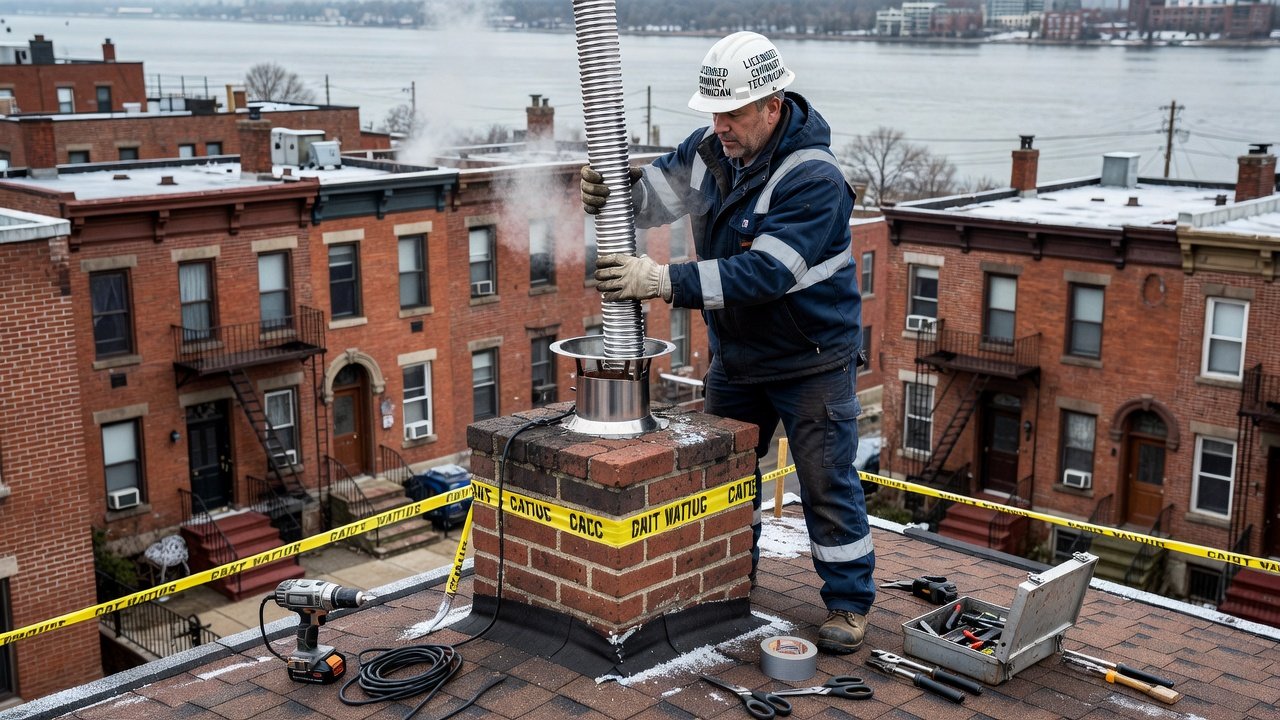
Chimney Liner Repair in Passaic
If you’re a Passaic homeowner wondering where to get reliable chimney liner repair, the answer is right here a licensed, local chimney specialist serving Passaic and its surrounding neighborhoods year-round. Before you call anyone, run through this quick checklist: Do you smell something acrid or smoky inside your home even when the fireplace isn’t in use? Have you spotted white staining or efflorescence creeping down your chimney’s exterior brickwork along Gregory Avenue or one of Passaic’s older residential blocks? Did your last heating-season fire seem to draw poorly, leaving more smoke in the room than up the flue? If you checked even one of those boxes, a damaged or deteriorated chimney liner is the most likely culprit and Chimney Liner Repair in Passaic is exactly what your home needs before another cold season arrives.
Chimney Passaic NJ is your local resource for chimney liner repair, inspection, and full relining, serving every corner of Passaic, from the dense rowhouses near the Passaic River waterfront to the attached brick two-families tucked along Paulison Avenue. Our technicians know this city’s housing stock, its weather patterns, and the specific liner failures that show up here not a generic service call, but real expertise grounded in local experience.
The Passaic Homeowner’s Checklist: Signs Your Liner Needs Attention Now
Passaic’s housing inventory is one of the oldest in Passaic County. Hundreds of homes throughout the Dundee Island corridor, the blocks surrounding Passaic High School on Passaic Avenue, and the neighborhoods abutting the border with Clifton were built between the 1890s and the 1950s. That means original clay tile liners some never upgraded are still in active service inside dozens of residential chimneys across the city.
Clay tile liners were designed to last 50 years under normal use. After that threshold, thermal cycling the repeated expansion and contraction caused by Passaic’s cold winters and humid summers causes tiles to crack, spall, and separate at the mortar joints. When that happens, combustion gases including carbon monoxide can migrate through the breach and seep into living spaces. This is not a cosmetic problem; it is a life-safety hazard.
Check your home for these specific warning signs:
- Black or gray smoke staining on the ceiling above the fireplace opening
- A persistent smoky odor in the house during humid summer months (common in Passaic’s river-adjacent neighborhoods where moisture levels stay elevated)
- Flaking clay tile debris visible in your firebox a clear sign of liner deterioration
- White efflorescence on exterior chimney masonry, indicating water has penetrated through a compromised liner
- A carbon monoxide detector that has alarmed without an obvious appliance cause
- Your chimney sweep’s most recent inspection report citing liner cracks or gaps
Any one of these signs justifies a professional liner inspection. Two or more signs means you should schedule service before your next use of the fireplace or gas appliance venting through that flue.
Why Passaic’s Specific Conditions Accelerate Liner Wear
Passaic sits in the Passaic River basin, which creates a particular microclimate challenge. The river valley traps humidity through spring and fall, driving moisture into aging masonry year after year. When that moisture saturates cracked clay tile liners or deteriorated mortar in an older chimney the kind you’ll find throughout the Wallington border blocks and the neighborhoods around Main Avenue near the old Passaic textile mills freeze-thaw cycles during winter turn minor cracks into structural failures with remarkable speed.
Additionally, a significant portion of Passaic’s housing stock was converted from oil heat to natural gas between the 1970s and 2000s. Natural gas appliances produce cooler, more acidic flue gases than the wood or coal fires those original liners were designed for. That acid condensate attacks unlined or inadequately sized flue passages over time, a problem that’s especially pronounced in Passaic’s older multifamily buildings along Hobart Avenue and in the Hamilton Avenue corridor near the border with Wallington and Garfield.
Homes in the Westside neighborhood and near Pennington Park that still rely on wood-burning fireplaces face a different but equally serious threat: creosote-accelerated deterioration. When the liner is cracked, creosote a byproduct of wood combustion penetrates into the surrounding masonry, raising chimney fire risk and making a full relining the only safe path forward.
Liner Repair vs. Full Relining: What Passaic Homes Typically Need
Not every liner problem demands a full reline. Here is how we typically approach the diagnosis for Passaic homes:
- CCTV Chimney Camera Inspection: Every liner job starts with a high-definition camera scan of the full flue length, from the firebox to the crown. This gives our technicians precise documentation of crack locations, tile separations, and mortar deterioration no guesswork, no unnecessary upselling.
- Targeted Repointing and Tile Repair: If the damage is isolated to one or two joints or a single tile section, and the surrounding liner material is structurally sound, targeted repair is appropriate and cost-effective. This is common in Passaic homes built in the 1940s and 1950s where only the upper flue sections near the crown have suffered weather damage.
- Cast-in-Place Liner Systems: For older Passaic chimneys with irregular or round flue shapes — often found in the original single-family colonials near Gregory Avenue and Howard Street — a cast-in-place liner creates a smooth, seamless insulated flue channel without the need to demolish existing masonry. This method is particularly well-suited to historic Passaic homes where preserving exterior brick appearance matters.
- Stainless Steel Flexible Liner Installation: The most common solution for Passaic homes converting to high-efficiency gas appliances or installing a wood stove. A properly sized stainless steel liner (typically 316-grade alloy with a minimum 0.006-inch wall thickness for residential gas applications) is inserted into the existing flue and anchored at the top and connected to the appliance at the base. This is the repair path most often recommended for Passaic homes along the Clifton and Garfield borders where HVAC upgrades are frequent.
Our Local Coverage: Passaic and the Surrounding Communities We Serve
Chimney Passaic NJ is based nearby and serves Passaic as a primary service area, along with the surrounding communities that share Passaic County’s aging housing challenges. If your home is in any of the following areas, we serve you directly — no subcontractors, no long waits for an out-of-area crew to make the drive:
- Passaic city neighborhoods: Dundee, Westside, the Main Avenue commercial corridor, Pennington Park area, and the residential blocks surrounding Passaic High School
- Clifton (especially Third Ward and Allwood, which border Passaic directly)
- Garfield (Lakeview and the routes along Passaic Street)
- Wallington (Boroughwide, adjacent to Passaic’s northern edge)
- Rutherford and Lyndhurst (eastern Passaic County residential zones)
- Nutley and Belleville (southern Passaic County/Essex County border communities)
- Paterson neighborhoods adjacent to Passaic
When you call us for chimney liner repair, you are speaking with someone who has been on rooftops throughout this service area who knows what to expect inside a Passaic triple-decker versus a 1930s Clifton colonial versus a 1980s Garfield ranch. That local knowledge speeds up diagnosis and keeps costs reasonable.
Frequently Asked Questions About Chimney Liner Repair in Passaic
My Passaic home was built in 1938 and still has the original clay tile liner. Is repair even possible, or do I need a full replacement?
It depends entirely on what our camera inspection reveals. Pre-war Passaic homes often have terra cotta tile liners that, despite their age, are still structurally intact in the lower two-thirds of the flue. If the damage is concentrated near the crown or at a single joint, targeted repair is often viable and cost-effective. However, if we find widespread tile separation or significant mortar loss throughout the flue which is common in Passaic homes that converted to gas heat decades ago without a liner upgrade a full stainless steel reline or cast-in-place system is the safer, longer-lasting answer. We will show you the camera footage and give you a straight recommendation, not the most expensive option.
Is chimney liner repair required by Passaic or New Jersey building code when I install a new gas furnace or water heater?
Yes, in most cases. New Jersey’s Uniform Construction Code, which Passaic enforces locally, requires that any new or replacement gas appliance installation be vented through a properly sized and code-compliant flue liner. If your existing liner is cracked, undersized for the new appliance’s BTU output, or is a bare masonry chase with no liner at all — a situation we see occasionally in older Passaic multifamily buildings — the HVAC contractor or building inspector will require liner work before the appliance installation is approved. Getting the liner repaired or replaced before your appliance installation avoids permit delays and repeat inspection fees.
How does the humidity near the Passaic River affect how quickly a repaired liner holds up?
River-adjacent moisture is a real factor for Passaic homeowners, particularly those within several blocks of the Passaic River along Gregory Avenue and the Dundee area. Elevated ambient humidity accelerates the acid-condensate cycle inside gas flues, and it also drives water into any hairline crack that wasn’t fully sealed during a repair. That is why we use high-temperature, waterproof refractory mortar not standard masonry mortar — on all liner joint repairs in Passaic, and why we recommend pairing any liner repair with a professionally applied chimney crown coat and a chimney cap if one is not already in place. A properly capped and sealed liner in a humid Passaic environment will outlast an uncapped one by many years.
Schedule Your Chimney Liner Repair in Passaic Today
Don’t wait until the smell of smoke inside your home or a carbon monoxide alarm tells you the problem has gotten worse. Chimney liner damage is progressive a small crack that is manageable today becomes a full structural failure after one more winter of freeze-thaw stress along Passaic’s river corridor. The right time to act is now, before heating season is in full swing and scheduling becomes difficult.
Contact Chimney Passaic NJ to book your chimney liner inspection and repair consultation. We serve Passaic and surrounding Passaic County communities with same-week appointments available for urgent situations. Call us or use our online contact form to describe your home, your appliance type, and what you’re experiencing we’ll give you an honest assessment and a clear, written estimate before any work begins.
Call Chimney Passaic NJ now to schedule your Chimney Liner Repair in Passaic. Protect your family. Protect your home. Get it done right.
Worth knowing
City chimneys work hard — multi-family flues, oil-to-gas conversions, and old brick all age faster than people think. Catching deterioration early keeps a repair from becoming a rebuild.